
NET examinations are important pathways for candidates who want to pursue university teaching, research fellowships, and doctoral studies in India. However, the term “NET” is used for more than one examination, and the paper pattern depends on which test you are taking.
This guide compares UGC NET, Joint CSIR-UGC NET, and State Eligibility Tests (SET). It puts the essential differences first, then explains how to choose the correct official syllabus, understand marking rules, and plan preparation without mixing up examination systems.
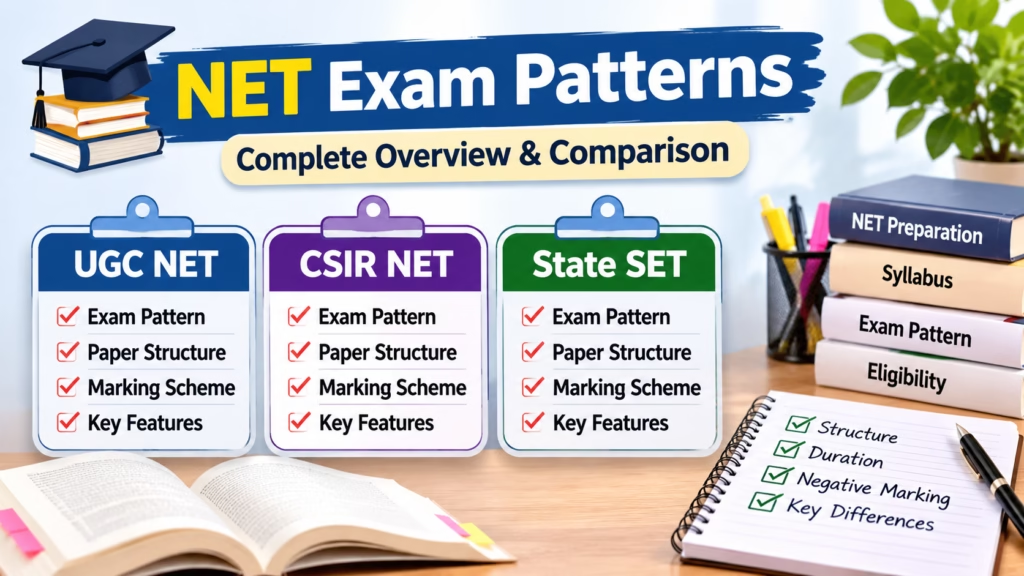
NET Exam Patterns at a Glance
| Examination | Typical structure | Duration | Marking and important distinction |
|---|---|---|---|
| UGC NET | Part I: 50 questions; Part II: 100 questions; all compulsory | 3 hours, no scheduled break | 300 marks; +2 per correct answer; no negative marking |
| Joint CSIR-UGC NET | One subject paper with Parts A, B and C; attempt limits vary by subject | 3 hours, no scheduled break | 200 marks; negative marking depends on subject and part |
| State Eligibility Test (SET) | Usually a general paper and a subject paper, but state rules differ | Check the relevant state notification | Mode, sessions, marking and eligibility vary by state |
Which NET examination should you prepare for?
- UGC NET: Usually relevant for candidates preparing in the subjects listed in the official UGC NET bulletin, including humanities, social sciences, commerce, and many other disciplines.
- Joint CSIR-UGC NET: Designed for the notified science subject areas, including Chemical Sciences, Earth Sciences, Life Sciences and Biotechnology, Mathematical Sciences, and Physical Sciences.
- SET: A state-level eligibility examination. Its recognition, subjects, examination mode, and eligibility rules must be checked with the specific state organizing authority.
UGC NET Exam Pattern 2026
UGC NET uses a single computer-based examination consisting of two parts without a scheduled break. Part I tests teaching and research aptitude, reasoning, comprehension, and general awareness. Part II tests knowledge of the selected subject. Both parts are compulsory, and the combined duration is 180 minutes.
| Part | Questions | Marks per question | Maximum marks |
|---|---|---|---|
| Part I | 50 | 2 | 100 |
| Part II | 100 | 2 | 200 |
| Total | 150 | — | 300 |
The UGC NET marking system does not deduct marks for incorrect responses. This matters when designing a time-management strategy: candidates should practice answering all questions, while still allocating sufficient time to read each option carefully. The official UGC NET bulletin explains the rules for questions that are dropped or found to have more than one correct answer.
The exact subject list, medium, and other instructions are published for each session. Candidates should use the official subject code and syllabus rather than assuming that a similarly named CSIR NET subject follows the same curriculum. Check the current UGC NET information bulletin.
Joint CSIR-UGC NET Exam Pattern 2026
Joint CSIR-UGC NET is a three-hour computer-based test with one 200-mark paper. The paper contains Part A for general aptitude, Part B for subject-related concepts, and Part C for analytical or application-oriented questions. Although the part names are the same across subjects, the number of questions available, maximum attempts, marks per answer, and negative marking are not identical.
| Subject | Questions offered | Maximum attempts | Maximum marks |
|---|---|---|---|
| Chemical Sciences | 120 | 75 | 200 |
| Earth, Atmospheric, Ocean and Planetary Sciences | 150 | 75 | 200 |
| Life Sciences and Biotechnology | 145 | 75 | 200 |
| Mathematical Sciences | 120 | 60 | 200 |
| Physical Sciences | 75 | 55 | 200 |
The most important difference is that students must respect their subject-specific attempt limits. Answering every visible question is not the correct strategy. For example, Mathematical Sciences Part C has no negative marking, whereas other parts and subjects apply deductions according to the official scheme.
For the full subject-wise Part A, B and C breakdown, use our dedicated CSIR NET exam pattern guide. It includes the detailed marking tables and explains how to use the question limits when practicing.
State Eligibility Test (SET) Exam Pattern
A State Eligibility Test is administered under a state-specific framework. The name SET does not guarantee one uniform national schedule or test delivery method. Students should first identify the state conducting the examination and then download the latest notification from the official authority.
For example, the Maharashtra–Goa SET July 2026 scheme specifies an OMR-based examination. Paper I has 50 compulsory questions for 100 marks and a one-hour session. Paper II has 100 questions for 200 marks and a two-hour session, with special response instructions for Mathematical Science. There is no negative marking under that published scheme.
This example demonstrates why a generic statement such as “all SET exams are computer-based” would be misleading. The pattern, paper timings, allowed languages, and recognition conditions should be confirmed for the exact state and session. Read the Maharashtra–Goa SET scheme.
UGC NET vs CSIR NET: Key Differences
UGC NET and CSIR NET can both be relevant to academic careers, but their test designs are not interchangeable. UGC NET uses 150 compulsory questions across two parts, while CSIR NET uses subject-dependent question selection across three parts. Their maximum marks also differ: 300 for UGC NET and 200 for CSIR NET.
The marking difference is especially important. UGC NET has no negative marking, while CSIR NET generally has negative marking with exceptions, such as Mathematical Sciences Part C. Candidates should therefore avoid applying one exam’s guessing strategy to the other.
How to select the right official syllabus
Choose your examination first and then match your subject to the official code. A similar subject name does not mean the units, weightage, or analytical depth will be identical. For CSIR NET, consult the CSIR HRDG syllabus and exam scheme; for UGC NET, consult the UGC NET syllabus list and the session bulletin.
After downloading the syllabus, divide it into foundational, intermediate, and advanced topics. Mark areas that recur in previous official papers and schedule revision based on your own weak areas. This approach is more dependable than studying from a generic “NET syllabus” checklist without checking which examination it covers.
Understanding negative marking and attempt limits
Negative marking changes the expected value of guessing. If a question carries a penalty, the decision to attempt it should depend on your confidence and the number of options you can eliminate. A blind guess may be less useful than spending the same time on a question you can solve reliably.
Attempt limits create another challenge: the computer-based interface may show more questions than are evaluated. In CSIR NET, exceeding the allowed number does not necessarily increase your score. Practice selecting your strongest questions early and verify the exact evaluation rule in the latest bulletin.
How to plan three hours in the examination
Start with a realistic mock test in the same format as your actual exam. Record how long you spend reading, solving, checking calculations, and reviewing flagged questions. Use that data to decide how much time each section deserves. There is no universally correct minute-by-minute division for every subject.
In the final weeks, rehearse with the correct number of questions, correct time limit, and correct marking rules. Review mistakes after every mock rather than simply counting scores. This will show whether your problem is missing concepts, slow calculations, poor question selection, or exam pressure.
How to use previous-year papers effectively
Previous papers help you understand wording, difficulty, and recurring themes, but they should not be treated as a guarantee of future questions. First solve a paper without assistance, then check the official answer key or a reliable worked solution. Record mistakes by topic and revisit the corresponding syllabus unit.
A useful practice routine combines timed papers with targeted topic revision. If your accuracy is good but you leave too many questions unfinished, focus on speed and selection. If you answer quickly but lose marks, focus on conceptual understanding and error analysis.
How qualification outcomes differ
The NET examination can relate to research fellowships, Assistant Professor eligibility, and PhD admission, depending on the examination and qualification category. A test result does not automatically guarantee admission, a fellowship placement, or employment. Institutions apply their own selection and verification procedures.
Joint CSIR-UGC NET identifies three result categories: JRF with Assistant Professor and PhD eligibility; Assistant Professor with PhD eligibility; and PhD admission only. Read our dedicated CSIR NET eligibility guide for academic requirements and age limits.
Documents and notices to check before applying
Use the official portal to verify the active application window, fees, correction dates, photograph and signature specifications, and identity-document requirements. Save the confirmation page and keep a record of your application number. Do not rely on an older article for administrative deadlines.
If you are applying under a reservation or relaxation category, check whether your certificate meets the format and date requirements in the current bulletin. A candidate may understand the syllabus perfectly and still face difficulty if a required document or declaration is incorrect.
A realistic preparation approach for beginners
Begin with the syllabus and a short diagnostic test. Make a weekly plan that includes concept study, practice questions, revision, and one longer test. A balanced routine is easier to sustain than a plan that requires many hours every day without room for rest or unexpected commitments.
Use textbooks for core understanding, official question papers for exam familiarity, and concise notes for revision. Compare your progress every two weeks and adjust the plan based on evidence. Consistent improvement in accuracy and confidence is more meaningful than the number of resources collected.
How to use this guide effectively
Start by identifying the exact decision you need to make about NET examination patterns. A candidate checking basic eligibility should not have to read a long preparation strategy first, while a student comparing question distributions should be able to reach the relevant table immediately. This guide therefore places the practical facts above the supporting explanations.
Read the official bulletin for your particular examination cycle before submitting an application. Exam bodies can revise schedules, definitions, accepted documents, or administrative procedures. An educational website can explain the rules, but it cannot replace the binding instructions issued by the examination authority.
Common mistakes students should avoid
One common mistake is to rely on a screenshot or social-media post without checking its date. Another is to assume that all NET examinations use the same rules because their names are similar. Always identify the examination, session, subject, and applicable official notice before making a decision about NET examination patterns.
Students also lose time when they collect many resources without a clear plan. Keep a short checklist, compare your own circumstances against the current requirements, and write down questions that remain unresolved. Where a rule depends on your degree, category, or institution, seek confirmation from the responsible authority rather than relying on an unsupported assumption.
Practical checklist before you proceed
Confirm the examination name and the relevant session. Download the official information bulletin and save a copy for reference. Locate the section addressing NET examination patterns, read the definitions and exceptions, and note any documents or deadlines that apply to you.
After checking the requirements, create a simple study or application calendar. Allow time for collecting certificates, verifying personal details, reviewing the syllabus, and practicing under realistic conditions. Keep a copy of official notices, application confirmations, and correspondence so that important information is easy to retrieve later.
Official sources and verification
For UGC NET, consult the official NTA UGC NET information bulletins. For Joint CSIR-UGC NET, use the official NTA CSIR NET documents page and CSIR HRDG examination scheme. For SET, consult the official portal of the relevant state authority. This guide was reviewed against documents available in November 2026.
Frequently Asked Questions (FAQs)
Are UGC NET and CSIR NET exam patterns the same?
No. UGC NET uses two compulsory parts worth 300 marks, while CSIR NET uses Parts A, B and C worth 200 marks with subject-specific attempt limits.
Does UGC NET have negative marking?
No. The official UGC NET marking scheme does not deduct marks for incorrect answers.
Does CSIR NET have negative marking in every part?
No. Most parts have deductions, but Mathematical Sciences Part C has no negative marking under the December 2026 scheme.
Is every SET examination computer-based?
No. State schemes differ; for example, the Maharashtra–Goa SET July 2026 scheme is OMR-based.
How long is the CSIR NET examination?
The examination lasts 180 minutes, or three hours, without a scheduled break between its parts.
Where can I check the latest NET examination rules?
Use the official NTA portals for UGC NET and CSIR NET, and the relevant state authority for SET.
Should I prepare from the same question papers for UGC NET and CSIR NET?
Use papers for your specific examination and subject. The question style, syllabus, and marking rules differ.
Can qualifying NET guarantee an Assistant Professor job?
No. Qualification establishes eligibility for the relevant category, subject to recruitment rules; appointment requires a separate selection process.