
Preparing for CSIR NET Chemical Sciences and unsure which reference books to choose? The right books can help you understand reaction mechanisms, inorganic structures, physical chemistry calculations and analytical methods without collecting more material than you can realistically study.
Below is a subject-wise list of recommended chemistry reference books, followed by explanations of how to use them, free and authorized study resources, and a downloadable PDF of our original book list. Match each recommendation with the Chemical Sciences syllabus and practise with previous-year question papers.
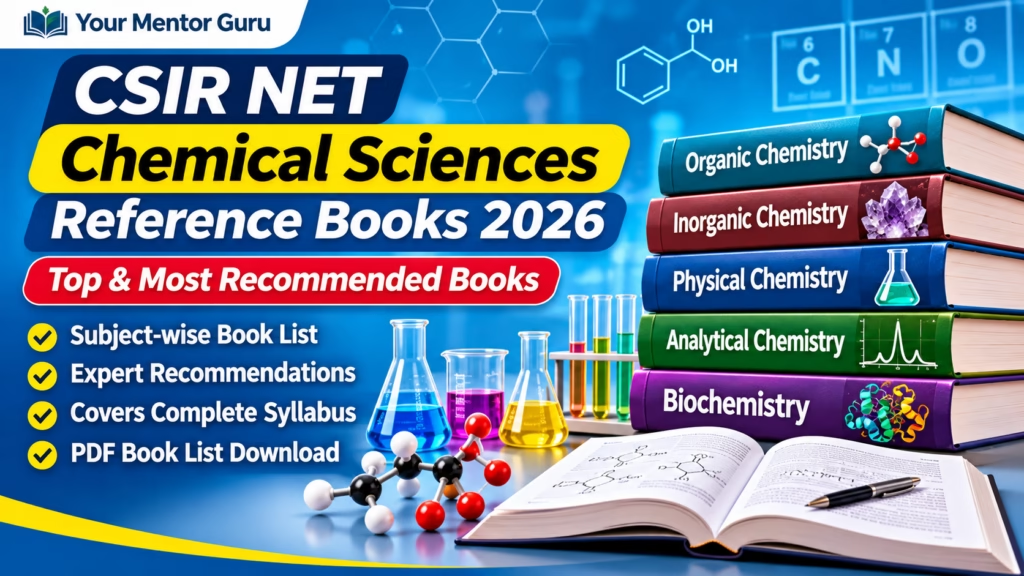
Reference books for CSIR NET Chemical Sciences, arranged by subject:
| Subject | Recommended book | Author(s) |
|---|---|---|
| Inorganic Chemistry | Concise Inorganic Chemistry | J. D. Lee |
| Inorganic Chemistry | Inorganic Chemistry | Gary L. Miessler, Paul J. Fischer and Donald A. Tarr |
| Organic Chemistry | Organic Chemistry | T. W. Graham Solomons, Craig B. Fryhle and Scott A. Snyder |
| Organic Chemistry | Organic Chemistry | Jonathan Clayden, Nick Greeves and Stuart Warren |
| Organic Chemistry | Organic Chemistry | O. P. Tandon |
| Physical Chemistry | Atkins’ Physical Chemistry | Peter Atkins, Julio de Paula and colleagues |
| Physical Chemistry | Physical Chemistry: A Molecular Approach | Donald A. McQuarrie and John D. Simon |
| Analytical Chemistry | Principles of Instrumental Analysis | Douglas A. Skoog, F. James Holler and Stanley R. Crouch |
CSIR NET Chemical Sciences Book List PDF
Our original downloadable PDF contains a short list of suggested reference books. It is a book-list document, not a PDF containing the complete commercial textbooks.
View / Download Chemistry Book List PDFFree Chemistry Textbooks and Study Resources
Many standard references listed above are commercial textbooks. For full-text access, use an authorized publisher edition or your institution’s library. These additional free resources are useful for chemistry fundamentals and selected exam topics.
OpenStax Chemistry 2e
A freely accessible general chemistry textbook. Useful for strengthening chemical principles, equilibrium, kinetics and electrochemistry.
Open free textbook / PDF optionsOpenStax Organic Chemistry
A free organic chemistry textbook; check the publisher page for available online and PDF formats.
View free organic chemistry textbookChemistry LibreTexts — Inorganic Chemistry
Open educational material covering inorganic chemistry topics. Download options vary by book.
Explore inorganic chemistryChemistry LibreTexts — Organic Chemistry
Open course materials and textbooks for mechanisms, structure and reactions.
Explore organic chemistryChemistry LibreTexts — Physical and Theoretical Chemistry
Free educational material on physical chemistry topics.
Explore physical chemistryChemistry LibreTexts — Analytical Chemistry
Open resources for analytical chemistry and instrumental techniques.
Explore analytical chemistryBest CSIR NET Chemical Sciences Reference Books — Detailed Subject-wise Guide
These are reference recommendations, not a requirement to read every book. Use one primary textbook for each area and consult another only when a topic needs more explanation.
Inorganic Chemistry
For inorganic chemistry, begin with periodic properties, chemical bonding, acid–base concepts and coordination chemistry. J. D. Lee is useful for building a foundation, while Miessler and colleagues provide greater depth in molecular orbital theory, symmetry and organometallic chemistry.
What to focus on: Compare geometries, oxidation states, crystal-field splitting and reaction pathways. Practise structure-based and reasoning questions rather than memorizing facts alone.
Organic Chemistry
Solomons and Fryhle provides a systematic foundation in functional groups, stereochemistry and reaction mechanisms. Clayden is particularly helpful for understanding why reactions occur, while O. P. Tandon can support targeted revision.
What to focus on: Draw electron-pushing mechanisms, identify intermediates, compare reagent selectivity and practise multistep synthesis problems.
Physical Chemistry
Atkins is a broad reference for thermodynamics, chemical kinetics, electrochemistry, quantum chemistry and spectroscopy. McQuarrie and Simon is useful when you need a more mathematical explanation of molecular physical chemistry.
What to focus on: Work through numerical problems on equilibrium, kinetics, thermodynamic functions, quantum models and spectroscopy; review assumptions and units.
Analytical and Spectroscopic Methods
Instrumental methods appear across chemistry topics. Skoog and colleagues can support concepts in chromatography, spectroscopy, electroanalytical methods and measurement. Standard organic and physical chemistry texts also help with interpretation of spectra.
What to focus on: Focus on the principle behind each technique, what a measurement reveals and how to interpret experimental data.
Interdisciplinary and Applied Chemistry
Use your main inorganic, organic and physical chemistry texts together with official syllabus topics and reliable university notes for interdisciplinary subjects such as materials chemistry, catalysis, polymers and chemistry in biology.
What to focus on: Choose resources by syllabus topic rather than trying to finish an unrelated specialist textbook.
CSIR NET General Aptitude Books
Part A assesses general aptitude rather than chemistry-specific knowledge. Use CSIR NET-style aptitude practice, reasoning questions and numerical exercises. An aptitude book can help, but solving timed questions and reviewing mistakes is especially important.
Do You Need Every Recommended Chemistry Book?
No. Start with one main text for inorganic, organic and physical chemistry. A second reference is useful only if you need a different explanation or deeper practice. Keep a short list of difficult topics and revisit those chapters rather than reading multiple textbooks cover to cover.
How to Use These Books During CSIR NET Preparation
- Read the corresponding topic in the current official syllabus.
- Study the concept from your main textbook and make concise notes.
- Solve relevant previous-year questions and topic-wise problems.
- Review errors and revisit only the concepts you missed.
- Use timed practice to build speed for calculation and application-based questions.
Can You Download CSIR NET Chemical Sciences Books as PDFs?
Some chemistry textbooks and educational materials are openly licensed, including selected OpenStax and LibreTexts titles. Commercial books such as Atkins, J. D. Lee and Solomons may require purchase or library access. A PDF found online is not automatically authorized for redistribution. The links above distinguish free educational resources from our downloadable list of book recommendations.
How to Choose the Right Reference Books for Chemical Sciences
- Check syllabus relevance: Prioritize chapters that match the exam topics.
- Match your level: Use an accessible introductory text before moving to advanced references.
- Balance theory and problems: Choose books with worked examples for physical chemistry and mechanism-based practice for organic chemistry.
- Limit the number of books: One primary reference per area is usually more manageable.
- Use recent editions when appropriate: Verify content and corrections, but do not assume the newest edition is essential for every topic.
Frequently Asked Questions
Which books are best for CSIR NET Chemical Sciences?
J. D. Lee and Miessler are useful for inorganic chemistry; Solomons and Clayden for organic chemistry; and Atkins or McQuarrie and Simon for physical chemistry. Choose according to your background and syllabus needs.
Is one book enough for the entire Chemical Sciences syllabus?
Usually not. The syllabus spans inorganic, organic, physical and interdisciplinary topics, so a small set of complementary references works better.
Where can I download a Chemical Sciences reference-book list PDF?
Use the book-list PDF link above. It lists recommended books and is separate from full textbook downloads.
Are all chemistry reference books available as free PDFs?
No. Some resources are openly available, while many standard textbooks are copyrighted commercial publications. Use official open textbooks or authorized library access.
Should I read textbooks before solving previous-year papers?
Start practising previous-year questions alongside your reading. They help identify which concepts need further study.
Which books help with numerical problems in physical chemistry?
Atkins and McQuarrie and Simon are useful references. Work through examples and practise timed problems on thermodynamics, kinetics, quantum chemistry and electrochemistry.
How should I prepare for Part A?
Practise reasoning, quantitative aptitude and data interpretation using CSIR NET-style questions, with regular timed sessions.
Also Check Out
Have a question about choosing chemical science reference books? Share the topic you are preparing for in the comments and we will try to help.