
Preparing for CSIR NET Earth, Atmospheric, Ocean and Planetary Sciences? Choosing suitable reference books is easier when you know which topics need a broad foundation and which require specialized reading. This guide brings together recommended books for geology, geophysics, meteorology, oceanography and planetary science.
Start with the Earth Sciences syllabus and practise using previous-year question papers. Below you will find the book list, our original downloadable PDF, free learning resources and detailed guidance for each subject.
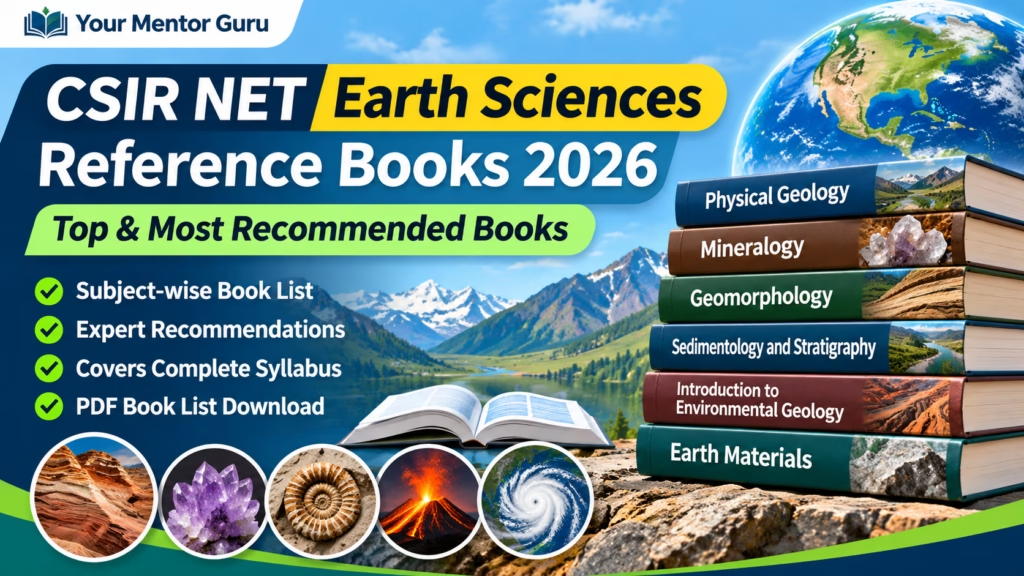
Recommended books for CSIR NET Earth Sciences, arranged by subject:
| Subject | Recommended book | Author(s) |
|---|---|---|
| Physical geology | Physical Geology | Charles C. Plummer, Diane H. Carlson and Lisa Hammersley |
| Mineralogy and crystallography | Mineralogy | Dexter Perkins |
| Geomorphology | Geomorphology | Edward A. Keller |
| Sedimentology and stratigraphy | Sedimentology and Stratigraphy | Gary Nichols |
| Environmental geology | Introduction to Environmental Geology | Edward A. Keller |
| Minerals, rocks and petrology | Earth Materials | Kevin Hefferan and John O’Brien |
| Structural geology | Structural Geology | Haakon Fossen |
| Geophysics | An Introduction to Geophysical Exploration | Philip Kearey, Michael Brooks and Ian Hill |
| Atmospheric sciences | Atmospheric Science: An Introductory Survey | John M. Wallace and Peter V. Hobbs |
| Ocean sciences | Introduction to Physical Oceanography | Robert H. Stewart |
| Planetary sciences | Introduction to Planetary Science | Gunter Faure and Teresa M. Mensing |
CSIR NET Earth Sciences Book List PDF
Download our original PDF containing a short list of recommended books. This file is a book-list PDF, not a collection of complete commercial textbooks.
View / Download Earth Sciences Book List PDFFree Earth Sciences Textbooks and Study Resources
Several useful resources are openly accessible. Some provide downloadable textbooks, while others provide free online chapters, maps, datasets or course materials. Check the provider’s page for the available format and reuse terms.
Mineralogy — Dexter Perkins (University of North Dakota)
Open-access mineralogy textbook, with a downloadable full-text file on the university repository.
Open textbook / downloadOpenGeology — Mineralogy
Current online version of Dexter Perkins’ open mineralogy textbook.
Read free textbookPhysical Geology — Open Textbook (BCcampus)
Free introductory geology textbook on rocks, tectonics, geological time and surface processes.
Read / find download optionsIntroduction to Physical Oceanography — Robert H. Stewart
Open oceanography textbook hosted by Texas A&M University.
Read free oceanography textUSGS Publications Warehouse
Free US Geological Survey reports, maps and scientific publications.
Find free reports / PDFsNOAA Education Resources
Free official material on oceans, weather, climate and atmospheric processes.
Explore free resourcesNASA Earth Observatory
Free Earth-system science explanations, satellite observations and graphics.
Explore Earth science resourcesNASA Planetary Science
Official educational information about planets, moons and the solar system.
Explore planetary scienceBest CSIR NET Earth Sciences Reference Books — Detailed Subject-wise Guide
Earth Sciences includes several specializations. The official syllabus covers common Earth-system concepts alongside more advanced material in geology, physical geography, geophysics, meteorology and ocean sciences. Choose books for the topics you are actually preparing, not merely because they appear on a long list.
Physical Geology and Earth-System Fundamentals
Recommended books: Physical Geology — Plummer, Carlson and Hammersley; Earth Materials — Hefferan and O’Brien.
Begin with the rock cycle, plate tectonics, geological time, earthquakes, volcanism and the structure of Earth. Physical Geology is suitable for an introductory overview, while Earth Materials helps connect minerals, rocks and their formation.
What to focus on: Use diagrams to compare igneous, sedimentary and metamorphic processes; practise questions on geological time and tectonic settings.
Mineralogy, Crystallography and Petrology
Recommended books: Mineralogy — Dexter Perkins; Earth Materials — Hefferan and O’Brien.
Mineralogy provides a foundation for crystal systems, mineral identification, optical properties and mineral chemistry. Earth Materials extends this knowledge into rock-forming processes and petrology.
What to focus on: Practise mineral identification, crystal symmetry, phase relationships and classification of common rocks.
Geomorphology and Physical Geography
Recommended books: Geomorphology — Edward A. Keller; Physical Geology — Plummer and colleagues.
Geomorphology helps explain how rivers, glaciers, wind, coasts and tectonic processes shape landscapes. Connect these processes to Indian landforms and the effects of weathering and erosion.
What to focus on: Compare erosional and depositional landforms and interpret drainage patterns, slopes and geomorphic maps.
Sedimentology, Stratigraphy and Palaeontology
Recommended books: Sedimentology and Stratigraphy — Gary Nichols.
Nichols is a focused reference for sedimentary environments, sediment transport, facies, depositional processes and stratigraphic interpretation. Use additional palaeontology resources for fossils and biostratigraphy.
What to focus on: Practise interpreting sedimentary structures, stratigraphic columns and depositional environments.
Structural Geology and Tectonics
Recommended books: Structural Geology — Haakon Fossen.
Structural geology develops the relationship between stress, strain and deformation in rocks. It supports folds, faults, joints, stereographic interpretation and tectonic processes.
What to focus on: Draw cross-sections and practise identifying structures from geological maps and block diagrams.
Geophysics and Earth’s Interior
Recommended books: An Introduction to Geophysical Exploration — Kearey, Brooks and Hill.
Use this reference for seismic, gravity, magnetic and electrical methods. Combine it with introductory geophysics notes to understand Earth’s interior and observational measurements.
What to focus on: Focus on the physical principles behind each method, data interpretation, units and basic numerical questions.
Atmospheric Sciences and Meteorology
Recommended books: Atmospheric Science: An Introductory Survey — Wallace and Hobbs.
This is a specialist reference for atmospheric structure, thermodynamics, radiation, clouds, weather systems and atmospheric dynamics. Supplement it with NOAA materials and Indian monsoon examples.
What to focus on: Understand lapse rates, atmospheric stability, pressure systems, monsoons, cyclones and circulation.
Ocean Sciences and Oceanography
Recommended books: Introduction to Physical Oceanography — Robert H. Stewart.
Stewart’s open textbook introduces ocean circulation, seawater properties, waves, tides and air–sea interaction. It is particularly useful for students who need a systematic introduction to physical oceanography.
What to focus on: Practise interpreting temperature–salinity patterns, ocean currents, thermohaline circulation and wave concepts.
Planetary Sciences and the Solar System
Recommended books: Introduction to Planetary Science — Gunter Faure and Teresa M. Mensing.
Use planetary science references to cover planetary formation, terrestrial planets, meteorites, planetary interiors and comparative planetology. NASA resources can help visualize planetary observations.
What to focus on: Compare planetary properties and review orbital concepts, meteorites and solar-system evolution.
Environmental Geology and Natural Hazards
Recommended books: Introduction to Environmental Geology — Edward A. Keller.
Environmental geology connects geological processes with hazards, water resources, environmental impacts and human activity. Use it as a supporting reference rather than a substitute for core geology texts.
What to focus on: Study earthquakes, landslides, groundwater, resource use and environmental applications.
CSIR NET General Aptitude Books
Part A covers general science, quantitative reasoning, analysis and research aptitude. Use a CSIR NET-focused aptitude question bank or reliable basic quantitative and reasoning materials. Timed practice and reviewing mistakes matter more than collecting several aptitude books.
Do You Need All These Earth Sciences Books?
No. Students focusing on geology will need a different combination of books from those focusing on meteorology, oceanography or geophysics. Start with one foundational geology or Earth-system text, then select one or two specialist references based on the syllabus and your weak areas.
How to Use Reference Books During Preparation
- Read the official syllabus and mark the topics relevant to your specialization.
- Choose one main textbook for each priority subject.
- Make concise notes with diagrams, maps, definitions and important equations.
- Solve previous-year questions after each topic and identify repeated difficulties.
- Use official data, geological maps and openly available diagrams to strengthen interpretation skills.
- Revise weak topics and practise timed analytical questions.
Can You Download CSIR NET Earth Sciences Books as PDFs?
Some educational materials, including Dexter Perkins’ open mineralogy textbook and selected open geology texts, are freely accessible from authorized sources. Many commercial references, such as Physical Geology and Earth Materials, require purchase or library access. Our original PDF above is a list of books rather than a download of the complete textbooks.
How to Choose the Right Reference Books for Earth Sciences
- Match your specialization: Select geology, geophysics, atmospheric science or oceanography references according to your exam preparation needs.
- Cover the common foundation: Do not skip Earth-system basics, minerals, tectonics and the atmosphere–ocean relationship.
- Choose the right difficulty: Use introductory books before advanced mathematical or specialist texts.
- Prioritize diagrams and problems: Look for worked examples, maps, cross-sections and data interpretation.
- Use authorized resources: Prefer open textbooks, official publications and institutional libraries.
Frequently Asked Questions
Which books are best for CSIR NET Earth Sciences?
For foundational geology, Physical Geology by Plummer and colleagues and Earth Materials by Hefferan and O’Brien are useful. Choose specialized references such as Nichols for sedimentology, Perkins for mineralogy, Wallace and Hobbs for meteorology, or Stewart for oceanography based on your syllabus needs.
Is one book enough for the entire Earth Sciences syllabus?
No. The examination covers several fields, including geology, geophysics, meteorology and ocean sciences. A few carefully chosen references are more useful than a single all-purpose book.
Where can I download the CSIR NET Earth Sciences book-list PDF?
Use the original book-list PDF button above. It contains recommendations rather than full copies of commercial textbooks.
Are any Earth Sciences textbooks available for free?
Yes. Dexter Perkins’ Mineralogy is openly available through the University of North Dakota, and open geology and oceanography materials are linked above. Download formats and permissions depend on the provider.
Which book should I use for mineralogy?
Dexter Perkins’ Mineralogy is a relevant introductory resource. Earth Materials by Hefferan and O’Brien is another option for minerals, rocks and petrology.
Which references help with meteorology and oceanography?
Atmospheric Science: An Introductory Survey by Wallace and Hobbs is useful for meteorology, while Robert H. Stewart’s Introduction to Physical Oceanography covers key ocean processes.
How should I prepare for Part A?
Practise general science, quantitative reasoning and research aptitude questions under time limits. Review errors and follow the current official exam instructions.
Should I solve previous-year papers while reading textbooks?
Yes. Topic-wise questions help you identify gaps early, and timed papers improve speed and exam readiness.
Also Check Out
Have a question about choosing earth science reference books? Share the topic you are preparing for in the comments and we will try to help.