
Preparing for the CSIR NET Mathematical Sciences examination? Choosing reference books that match the syllabus is more useful than collecting every popular mathematics textbook. This guide brings together trusted references for analysis, algebra, differential equations, topology, numerical methods and other relevant areas.
Start with the books listed below, use the downloadable book-list PDF for quick reference, and strengthen your preparation with the Mathematical Sciences syllabus and previous-year question papers and answer keys.
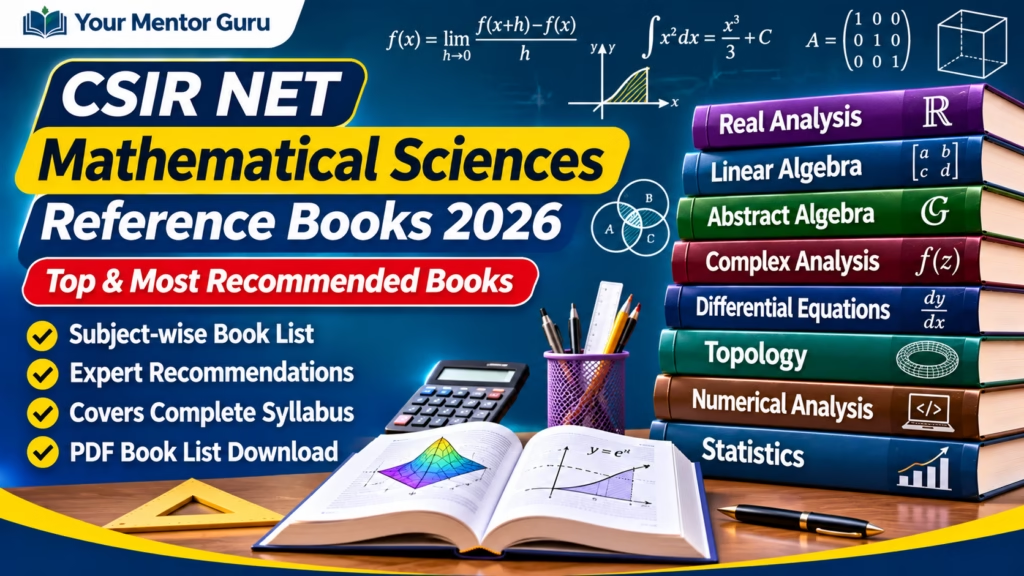
Recommended Books for CSIR NET Mathematical Sciences
The table retains the books from our original reference collection, with additional topic guidance. Not every book is essential; choose based on the official syllabus and your weaker topics.
| Book | Author(s) | Useful for |
|---|---|---|
| Real Analysis | H. L. Royden and P. M. Fitzpatrick | Measure theory and advanced real analysis |
| Linear Algebra | Kenneth Hoffman and Ray Kunze | Vector spaces, linear transformations and canonical forms |
| Complex Analysis | Elias M. Stein and Rami Shakarchi | Analytic functions, contour integration and residues |
| Abstract Algebra | David S. Dummit and Richard M. Foote | Groups, rings and fields |
| Ordinary Differential Equations | Morris Tenenbaum and Harry Pollard | First- and higher-order differential equations |
| Fundamentals of Mathematical Statistics | S. C. Gupta and V. K. Kapoor | Probability and mathematical statistics |
| Integral Equations and Boundary Value Problems | M. D. Raisinghania | Integral equations and boundary-value techniques |
| Principles of Mathematical Analysis | Walter Rudin | Rigorous foundations of real analysis |
| How to Become a Human Calculator | Aditi Singhal | Optional mental arithmetic practice; not a core mathematics reference |
| Topology | James R. Munkres | Topological spaces, continuity and compactness |
| Introductory Functional Analysis with Applications | Erwin Kreyszig | Normed spaces, Hilbert spaces and operators |
| Numerical Analysis | Richard L. Burden and J. Douglas Faires | Numerical methods and error analysis |
Download the CSIR NET Mathematical Sciences Book List PDF
Download our existing PDF containing a recommended list of books. This file is a book list, not a free copy of the commercial textbooks.
View book-list PDFDownload book-list PDF
If the PDF preview does not appear on your device, use the button above.
Free Mathematics Textbooks and Study Resources
These resources offer legitimate free learning materials. Some have downloadable PDF books; others provide online chapters, lecture notes or courses. Check the provider’s page for the available formats.
OpenStax Calculus, Volumes 1–3
Free, openly licensed calculus textbooks covering limits, differentiation, integration and multivariable calculus.
Browse free calculus textbooksMIT OpenCourseWare — Mathematics
Free course notes, assignments and selected lecture materials for linear algebra, analysis and differential equations.
Explore mathematics coursesMathematics LibreTexts
Open mathematics chapters and textbook collections spanning calculus, algebra, statistics and more.
Read open textbooksOpen Textbook Library — Mathematics
Catalog of open textbooks; use individual listings to check access and PDF availability.
Browse mathematics textbooksNPTEL Mathematics Courses
Free university-level lectures and course materials, useful for higher mathematics revision.
Explore NPTEL coursesDetailed Subject-wise Guide to CSIR NET Mathematical Sciences Books
Use these topic-based recommendations to select a primary textbook and one supplementary reference where necessary. The exact breadth of each area should be checked against the current syllabus.
Real Analysis and Measure Theory
Recommended books:
- Principles of Mathematical Analysis — Walter Rudin
- Real Analysis — H. L. Royden and P. M. Fitzpatrick
Begin with sequences, series, continuity, differentiability and Riemann integration. Move to measure and Lebesgue integration when required. Rudin is concise and proof-oriented; Royden provides deeper coverage of measure theory. Practise writing complete proofs rather than memorizing theorem statements.
Linear Algebra
Recommended books:
- Linear Algebra — Hoffman and Kunze
- Linear Algebra Done Right — Sheldon Axler
Prioritize vector spaces, bases, dimension, rank, eigenvalues, diagonalization, inner-product spaces and linear operators. Hoffman and Kunze is a strong theoretical reference; Axler can help develop conceptual understanding.
Complex Analysis
Recommended books:
- Complex Analysis — Stein and Shakarchi
- Complex Variables and Applications — Brown and Churchill
Focus on analytic functions, Cauchy’s theorem, Taylor and Laurent series, singularities and residue calculations. Use a more accessible text for worked examples if the proof-heavy treatment is difficult.
Abstract Algebra
Recommended books:
- Abstract Algebra — Dummit and Foote
- Contemporary Abstract Algebra — Joseph A. Gallian
Study groups, homomorphisms, quotient structures, rings, ideals and fields. Dummit and Foote is comprehensive but demanding; Gallian is often easier for first-pass learning.
Ordinary and Partial Differential Equations
Recommended books:
- Ordinary Differential Equations — Tenenbaum and Pollard
- Partial Differential Equations — Lawrence C. Evans
For ODEs, master solution techniques, linear systems and qualitative ideas. For PDEs, focus on classical equations, boundary conditions and standard solution methods. Evans is advanced; use introductory notes before attempting its deeper theory.
Topology and Functional Analysis
Recommended books:
- Topology — James R. Munkres
- Introductory Functional Analysis with Applications — Erwin Kreyszig
For topology, study open and closed sets, compactness, connectedness and continuity. For functional analysis, review normed and Hilbert spaces, bounded operators and foundational results as required by the syllabus.
Numerical Analysis
Recommended books:
- Numerical Analysis — Burden and Faires
- Numerical Methods for Scientific and Engineering Computation — M. K. Jain, S. R. K. Iyengar and R. K. Jain
Work on root-finding, interpolation, numerical integration, numerical solution of differential equations and error estimation. Solve computations by hand before relying on software.
Probability and Statistics
Recommended books:
- Fundamentals of Mathematical Statistics — Gupta and Kapoor
- A First Course in Probability — Sheldon Ross
Concentrate on random variables, distributions, expectation, variance, convergence, estimation and hypothesis testing where included in the syllabus. Build speed with numerical practice.
Integral Equations and Boundary Value Problems
Recommended books:
- Integral Equations and Boundary Value Problems — M. D. Raisinghania
Use this as a supplementary reference for Fredholm and Volterra equations and boundary-value methods when these are part of your chosen preparation topics. Match chapters to the syllabus rather than attempting the entire text.
Calculus of Variations and Classical Mechanics
Recommended books:
- Calculus of Variations — I. M. Gelfand and S. V. Fomin
- Classical Mechanics — Herbert Goldstein
These can support applied-mathematics topics such as variational principles and mechanics where relevant to the syllabus. They are not substitutes for the main analysis and algebra references.
CSIR NET General Aptitude Books
Part A assesses general aptitude rather than advanced mathematics. Use the official question pattern and previous-year papers to practise quantitative reasoning, logical reasoning, data interpretation and general science. Aditi Singhal’s How to Become a Human Calculator may help with calculation speed, but it is not a replacement for CSIR NET-specific aptitude practice.
How to Use These Books During Preparation
- Choose one main textbook for each topic instead of trying to finish every book.
- Read the relevant theorem or concept, then solve worked examples without looking at the solution.
- Attempt topic-wise previous-year questions early and maintain a notebook of proof and calculation mistakes.
- Reserve separate time for Part A aptitude and timed mock tests.
- Use free open textbooks and lecture notes to fill specific gaps rather than downloading large collections you will not study.
Can You Download CSIR NET Mathematical Sciences Books as PDFs?
The book-list PDF above is available from our existing website. Standard references such as Rudin, Royden, Hoffman and Kunze, and Dummit and Foote are commercially published books, so free copies found online are not necessarily authorized. For full textbooks, use publishers, university libraries or legitimate open-textbook providers such as those linked above.
How to Choose the Right Reference Books
- Start with the syllabus: identify which topics are included and how deeply they are tested.
- Match your level: use introductory explanations before moving to proof-heavy advanced texts.
- Check worked problems: a good reference should help you practise, not just read definitions.
- Balance theory and practice: mathematics preparation requires both proof-writing and problem-solving.
- Check editions and access: choose authentic books and authorized resources; the newest edition is not always essential for established mathematics topics.
Frequently Asked Questions
Which books are best for CSIR NET Mathematical Sciences?
Rudin and Royden are useful for analysis; Hoffman and Kunze for linear algebra; Dummit and Foote for algebra; and Stein and Shakarchi for complex analysis. The best combination depends on your preparation level and syllabus needs.
Is one reference book enough for the full Mathematical Sciences syllabus?
No. The syllabus spans several branches of mathematics. Choose a small set of core references and use targeted supplementary books for weaker areas.
Where can I download the Mathematical Sciences book-list PDF?
Use the preview and download buttons above. The PDF lists recommended books and is not a bundle of full commercial textbooks.
Are free mathematics textbooks available legally?
Yes. OpenStax, Mathematics LibreTexts and open-textbook repositories offer legitimate free learning materials. Check each provider for PDF download options and licensing.
Which book is useful for real analysis?
Principles of Mathematical Analysis by Walter Rudin is a rigorous reference, while Real Analysis by Royden and Fitzpatrick is useful for deeper measure-theoretic topics.
Which books should I use for linear and abstract algebra?
Hoffman and Kunze is useful for linear algebra; Dummit and Foote is a comprehensive abstract algebra reference. More introductory alternatives may be helpful if you are starting from the basics.
Do I need advanced textbooks for every topic?
No. Use an advanced text when the syllabus or a difficult concept calls for it. Introductory notes and previous-year questions may be more efficient for revision.
Should I practise previous-year questions while studying books?
Yes. Practise questions topic by topic after learning the main ideas, then attempt timed papers to improve accuracy and speed.
Also Check Out
Have a question about choosing mathematics reference books? Share the topic you are preparing for in the comments and we will try to help.