
Are you planning to appear for the CSIR NET examination but feeling unsure about where to begin? With so much information available about eligibility, the syllabus, exam patterns and preparation resources, getting started can sometimes feel overwhelming.
The Joint CSIR-UGC NET is an important national-level examination for science graduates and postgraduates who want to pursue research, qualify for teaching opportunities in higher education, or progress towards a PhD.
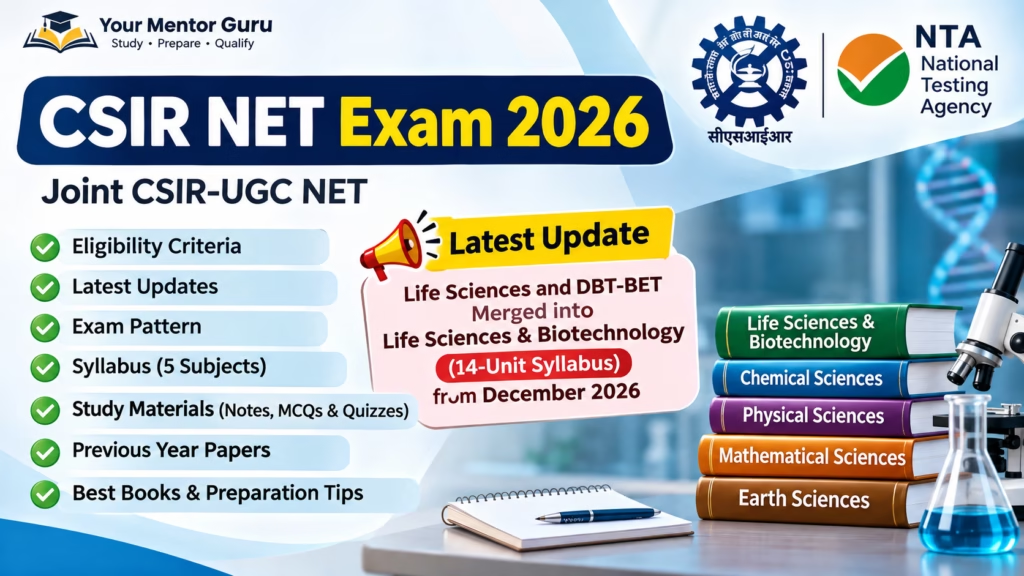
This guide brings together the essential information about CSIR NET 2026, including the latest examination updates, subject-wise syllabus, eligibility, preparation materials, previous-year question papers and useful study resources.
Whether you are preparing for Life Sciences, Chemical Sciences, Physical Sciences, Mathematical Sciences or Earth Sciences, you can use this page as your starting point.
What Is the CSIR NET Examination?
The Council of Scientific and Industrial Research–University Grants Commission National Eligibility Test, commonly known as CSIR NET, is conducted by the National Testing Agency (NTA).
The examination assesses candidates’ subject knowledge, scientific understanding, analytical ability and research aptitude.
Depending on their performance and applicable eligibility requirements, successful candidates may qualify for:
- Junior Research Fellowship (JRF): An opportunity to pursue research with fellowship support, subject to the applicable rules.
- Assistant Professor eligibility: Qualification for recruitment to eligible teaching positions in higher education.
- PhD admission: Eligibility for doctoral admission under the applicable category and institutional admission rules.
Qualifying CSIR NET does not automatically guarantee a job, fellowship placement or PhD admission. Candidates must also satisfy the requirements of the relevant institution or fellowship programme.
CSIR NET 2026: Examination Overview
| Particulars | Details |
|---|---|
| Examination name | Joint CSIR-UGC NET |
| Conducting agency | National Testing Agency (NTA) |
| Examination level | National |
| Mode | Computer-Based Test (CBT) |
| Duration | 3 hours |
| Maximum marks | 200 |
| Question type | Multiple-choice questions |
| Sections | Part A, Part B and Part C |
| Examination subjects | Five science disciplines |
| Official website | csirnet.nta.nic.in |
CSIR NET December 2026: Latest Updates
The December 2026 examination cycle is particularly important for candidates preparing in the biological sciences.
1. CSIR NET Life Sciences and DBT-BET Merger
CSIR has introduced a unified Life Sciences and Biotechnology (LS & BT) examination by merging CSIR NET Life Sciences with the DBT Biotechnology Eligibility Test (BET), effective from the December 2026 examination cycle.
The revised syllabus contains 14 units, bringing together foundational biological sciences and important areas of biotechnology.
Candidates preparing for the December 2026 examination should follow this revised syllabus rather than relying entirely on the older 13-unit structure.
Download the Official Revised Life Sciences and Biotechnology Syllabus
2. December 2026 Application Update
The National Testing Agency has opened online applications for the December 2026 CSIR NET examination.
As announced in the application schedule, the deadline for submitting applications and paying the examination fee is 5 November 2026, up to 11:50 PM.
Candidates should check the official website for the examination date, correction window, admit card, city intimation slip and any subsequent changes.
Visit the Official CSIR NET Application Website
Last updated: 31 October 2026. Examination schedules and application deadlines may change through official notices.
CSIR NET 2026 Important Dates
| Event | Status |
|---|---|
| December 2026 notification | Released |
| Online applications | Open |
| Application and fee payment deadline | 5 November 2026, 11:50 PM |
| Application correction | Check official notification |
| Examination date | Check official notification |
| Admit card | To be announced |
| Answer key | After examination |
| Result | To be announced |
For the most accurate schedule, always refer to the NTA CSIR NET announcements.
CSIR NET Eligibility Criteria 2026
Before applying, candidates should review the eligibility conditions carefully. These include educational qualifications, qualifying marks, age requirements and category-specific relaxations.
Educational Qualification
Candidates generally need a relevant postgraduate qualification or another recognised qualification covered by the current information bulletin.
Eligibility routes may include:
- A master’s degree or equivalent qualification in a relevant discipline.
- Eligible four-year undergraduate degree programmes, subject to the specific conditions for JRF and PhD admission.
- Candidates appearing in their qualifying examinations, where provisional eligibility is permitted.
The minimum qualifying marks, accepted degree combinations and final-year conditions depend on the eligibility route and category.
Age Limit
The age rules are not identical for all qualification categories.
- JRF: An upper age limit applies, with relaxations for eligible categories.
- Assistant Professor eligibility: There is generally no upper age limit.
- PhD admission: Age conditions are governed by the applicable admission rules.
Candidates should verify the exact age cut-off date, relaxation provisions and qualification requirements in the official 2026 information bulletin before applying.
CSIR NET 2026 Subjects
CSIR NET covers five broad science disciplines. Candidates should choose the subject that corresponds to their academic background and eligibility.
| Subject | Main areas of preparation |
|---|---|
| Life Sciences and Biotechnology | Molecular biology, genetics, cell biology, physiology, biotechnology and research methods |
| Chemical Sciences | Organic, inorganic, physical and analytical chemistry |
| Physical Sciences | Classical mechanics, quantum mechanics, electromagnetism and related topics |
| Mathematical Sciences | Algebra, analysis, differential equations, statistics and applied mathematics |
| Earth, Atmospheric, Ocean and Planetary Sciences | Geology, geophysics, meteorology, oceanography and related disciplines |
Explore the Subject-Wise Syllabus
- CSIR NET Life Science Syllabus
- CSIR NET Chemical Science Syllabus
- CSIR NET Physical Science Syllabus
- CSIR NET Mathematical Science Syllabus
- CSIR NET Earth Science Syllabus
Important: The existing Life Science syllabus and study resources on this website may follow the earlier 13-unit structure. Candidates appearing from December 2026 onward should compare those resources with the revised official 14-unit syllabus.
CSIR NET Exam Pattern 2026
The examination consists of a single paper divided into three parts. The overall duration is three hours, and the maximum score is 200 marks.
| Section | Focus | Maximum marks |
|---|---|---|
| Part A | General aptitude and reasoning | 30 |
| Part B | Subject knowledge and conceptual understanding | 70 |
| Part C | Scientific application, analysis and problem-solving | 100 |
| Total | 200 |
Part A: General Aptitude
Part A evaluates skills that are useful across scientific disciplines.
Common areas include:
- Quantitative reasoning
- Logical and analytical ability
- General science
- Research aptitude
- Data interpretation
Part B: Subject-Based Questions
Part B focuses on understanding the fundamental concepts of the selected subject.
Students should develop a clear understanding of definitions, principles, processes and relationships between important topics.
Part C: Analytical and Application-Based Questions
Part C is designed to test how effectively candidates apply scientific knowledge.
Questions may require candidates to:
- Interpret experimental results.
- Analyse scientific data.
- Apply concepts to unfamiliar situations.
- Solve multistep problems.
- Evaluate research-based scenarios.
Negative marking: Incorrect answers can attract negative marks. The exact marking rules, number of questions and permitted attempts vary by subject, so candidates should consult the current subject-wise examination scheme.
CSIR NET Life Sciences and Biotechnology: Revised 2026 Syllabus
The revised Life Sciences and Biotechnology syllabus contains the following 14 units:
- Structure and Function of Biomolecules
- Cellular Organization
- Fundamental Processes
- Cell Communication and Cell Signaling
- Developmental Biology
- System Physiology – Plant
- System Physiology – Animal
- Inheritance Biology
- Evolution and Diversity of Life Forms
- Ecology and Behavioural Biology
- Bioinformatics and Computational Biology
- Biochemical Engineering and Industrial Biotechnology
- Advances in Biotechnology
- Methods in Biology
The revised syllabus introduces stronger coverage of biotechnology and computational biology while retaining many essential topics from the earlier Life Science syllabus.
Students who have already prepared from the older 13-unit syllabus do not need to discard everything they have studied. Much of the foundational content remains relevant, but additional topics and revised unit groupings must be covered.
Read the CSIR NET Life Science Study Materials
CSIR NET Study Materials: Notes, MCQs, Quizzes and Practice Resources
Good preparation requires more than reading textbooks. Students need a combination of conceptual learning, regular revision and question-solving practice.
At Your Mentor Guru, the study-material pages are designed to bring different types of preparation resources together in one place.
These may include:
- Topic-wise and unit-wise notes
- Multiple-choice questions with answers
- Practice quizzes
- Important concepts and explanations
- Previous-year question papers
- Reference books and other learning resources
Explore All CSIR NET Study Materials
CSIR NET Life Science Study Materials
Students preparing for Life Sciences and Biotechnology can begin with the existing unit-wise study resources.
- Unit 1 Study Materials
- Unit 2 Study Materials
- Unit 3 Study Materials
- Unit 4 Study Materials
- Unit 5 Study Materials
- Unit 6 Study Materials
- Unit 7 Study Materials
- Unit 8 Study Materials
- Unit 9 Study Materials
- Unit 10 Study Materials
- Unit 11 Study Materials
- Unit 12 Study Materials
- Unit 13 Study Materials
These pages were developed around the previous syllabus and should be used alongside the revised syllabus for the December 2026 cycle.
CSIR NET Life Science Notes
If you prefer focused reading and revision, dedicated notes pages can help you review individual concepts without going through an entire collection of practice resources.
Explore Unit 1 Life Science Notes
CSIR NET Previous Year Question Papers
Solving previous-year question papers is one of the most useful ways to understand the examination.
They help you recognise the types of questions asked, identify frequently tested concepts and improve your ability to solve problems under time pressure.
Download Subject-Wise Question Papers
- Life Science Previous Year Question Papers
- Chemical Science Question Papers
- Physical Science Question Papers
- Mathematical Science Question Papers
- Earth Science Question Papers
For Life Sciences and Biotechnology, older papers remain useful for practising shared concepts, but they do not fully represent the revised 2026 syllabus.
Best Books for CSIR NET Preparation
A good reference book should help you understand difficult concepts rather than simply provide more information to memorise.
Start with a limited number of reliable textbooks, complete the relevant syllabus and use previous-year questions to identify areas that need further study.
Explore Subject-Wise Book Recommendations
- CSIR NET Life Science Books
- Best Books for CSIR NET Life Science
- Best Books for Chemical Science
- Best Books for Physical Science
- Best Books for Mathematical Science
- Best Books for Earth Science
You can also visit our CSIR NET Reference Books collection for additional reading resources.
How to Prepare for CSIR NET 2026
Preparing for CSIR NET becomes easier when you follow a realistic study plan instead of trying to complete everything at once.
Step 1: Understand the Latest Syllabus
Download the official syllabus for your subject and identify the topics you already know.
For Life Sciences and Biotechnology, make sure you are following the revised syllabus applicable from December 2026.
Step 2: Strengthen Your Fundamentals
Begin with core concepts before moving to difficult analytical questions. Use textbooks and explanatory notes to understand why a process occurs, not just what happens.
Step 3: Practise MCQs Regularly
After completing a topic, solve questions related to it. Review incorrect answers and revisit the concepts that caused confusion.
Step 4: Focus on Part C
Dedicate regular study time to analytical questions, experiments, graphs and application-based problems.
Part C requires understanding and reasoning, so memorisation alone is unlikely to be enough.
Step 5: Revise and Attempt Mock Tests
Reserve time each week for revision and timed practice.
Track the topics where you lose marks, and gradually improve both accuracy and speed.
Frequently Asked Questions About CSIR NET 2026
Is CSIR NET conducted twice a year?
CSIR NET has generally been conducted in June and December cycles. Candidates should confirm each session through the official NTA notifications.
What is the difference between CSIR NET JRF and Assistant Professor eligibility?
JRF qualification relates to eligibility for research fellowship opportunities, while Assistant Professor qualification relates to eligibility for teaching recruitment. The examination result and applicable criteria determine the category for which a candidate qualifies.
Is there negative marking in CSIR NET?
Yes, negative marking applies to specified sections and subjects. The deduction varies according to the subject and question type.
Has the CSIR NET Life Science syllabus changed in 2026?
Yes. From the December 2026 cycle, the Life Sciences examination is integrated with Biotechnology, and the revised syllabus contains 14 units.
Can I prepare for CSIR NET using free study materials?
Yes. Free notes, practice MCQs, previous-year papers and quizzes can support preparation. However, students should check that the resources cover the latest syllabus and use standard reference books where deeper understanding is needed.
Are previous-year Life Science question papers still useful after the syllabus revision?
Yes. Previous papers remain valuable for practising fundamental concepts, but students must also prepare newly introduced biotechnology and computational biology topics.
Official CSIR NET 2026 Websites and Resources
For notifications, eligibility conditions, examination schedules and official syllabus documents, refer to:
- NTA Joint CSIR-UGC NET Official Website
- NTA Information Bulletins and Notifications
- CSIR HRDG Official Syllabus
- Revised Life Sciences and Biotechnology Syllabus PDF
Final Thoughts
CSIR NET preparation is not about studying for the longest number of hours. It is about understanding the syllabus, learning the concepts thoroughly and practising how to apply them.
The December 2026 syllabus revision is an important change for Life Science and Biotechnology candidates, but a strong foundation in biology remains valuable. By combining that foundation with the newly introduced topics, regular question practice and thoughtful revision, you can prepare more confidently.
Explore the CSIR NET Study Materials and build a preparation routine that works for you.
Disclaimer: Your Mentor Guru is an independent educational website and is not affiliated with NTA, CSIR or UGC. Candidates should verify examination details and eligibility requirements through official notifications.